Tuesday, June 17, 2014

The Three P's Collide #4

              During class, students gathered in groups based on their topic to create a final project to present to the class. Group members discussed the key terms and enduring understandings that they felt were important, and then decided which ones were the most valuable. Each group created about 3 to 4 introduction slides that explained their topic’s background information and the key terms for their topic. Groups wrote the main points on each slide, but then explained in detail the concept of the slides in order to teach the class about their topics. After presenting the background slides, groups showed the Videolicious videos that they created. Each video was no more than 60 seconds longs with 6 images per video. For each picture in the video, students recorded the explanations of how each image relates to the People, Power, and Places theme. After the information slides, the groups created a bibliography and pictography that cited any readings or images that were used for the project. Following the video and information slideshow, students in the audience took a survey on SurveyMonkey.com that the group presenting created. The survey asked questions that required the students to use the information that the group just presented, with a variety of multiple choice and short answer questions. When students completed the survey, the group presenting discussed the questions and answers of the survey. Students learned how each topic relates to the People, Places and Power theme from each group’s presentations.

Imperialism in America:
                America defeated Spain in the Spanish American War, which was ended by the Treaty of Paris, and because of this defeat, America had power over Spanish countries. The United States invaded Cuba because the U.S. wanted more fertile land to boost the economy, to gain naval bases outside of the U.S., to unite America with patriotism, and to protect American soldiers that were in Cuba who the U.S. thought were in danger. America was able to dominate Cuba because it had more power.
European Imperialism in Africa:
                The European belief that they had power over Africans because of their evolution, called Social Darwinism, gave the idea to Europeans that they had the right to divide Africa among themselves. King Leopold II was greedy since he had power, and therefore exploited the Congo Free State. Under his control, Leopold manipulated the citizens of the Congo Free State to convince them to work for him under harsh conditions.
Labor vs. Big Business:
                People who created big businesses, like Rockefeller, Morgan, Carnegie, and Pullman, were powerful. The amount of money gained by large corporations led to power in small numbers of people. People without power who worked in the same place would join together in groups to gain power in order to fight against the powerful people who controlled them.
Immigration from Asia:
                In 1920, over 200,000 Japanese came to America, but there were many laws that restricted immigrants from coming into the country. The Chinese Exclusion Act of 1882 stopped Chinese laborers from entering America, the Webb Alien Law prohibited foreigners without citizenship in America from owning land in 1913, and immigration laws prevented immigrants from achieving the American dream. Angel Island was the main immigration center in California that was made in 1910 where immigrants went through physical exams to see if they were healthy enough to enter America.
European Immigration:
                European immigrants who arrived in America were restricted to becoming a citizen easily by people who were in power. Pogrom organized the persecution of Jews and restrictive covenants limited the sale of property to immigrants.


Friday, June 13, 2014

The Three P's Collide #3

I was able to learn many new things about Native Americans in the West by chatting with my group about our research. I was exposed to more enduring understandings and key terms by working with my peers. For one example, I never considered that even though people in power were causing harm to others, they may have thought of themselves as doing the right thing. Craig enlightened me on this enduring understanding, as well as the understanding that General George Armstrong Custer was harmful to the Indians, even though he sympathized for them. Discussing the topic with my group made me realize that many of the people who were in power of the Native Americans treated the Native Americans poorly, even if not on purpose. Also, I was reminded by my group members that some people would do drastic things to be in power or to maintain their home. For example, Easterners killed many Indians, including women, children and chief Sitting Bull, in order to gain territory and power in the West. I gained a better understanding of the effects that people in power had and the views of the people in power from conversation within my group.

In general, this project was an enjoyable way to learn about our topic, but my group had a few glitches along the way.When we first began making our Videolicious, my group was concerned about the timing. Since we only had about six seconds per image to record our caption, we were afraid that either we would not be able to fit all of the captions in or that we would need to talk too fast. After a few trial runs, we found the right pace to speak in order to fit all of the captions in, and even with two seconds remaining to record! Even though our photo essay turned out to be a success, our introduction slides needed some tweaking right at the end of class, which was frustrating. We learned to only write the major points on each slide instead of paragraphs to read off of. I wish I had the opportunity to help more with the Videolicious App because I spent a majority of the class time creating the introduction slides. Overall I enjoyed creating this project because it was an interesting way to show to the class what we have learned about our topics.

Link to my Video Essay: http://video.videolicious.com/36ab0599-03be-41b5-9984-8c607659400e

Thursday, June 5, 2014

The Three P's Collide #2

I have recently gained more understanding about the Native Americans in the West, and now I have added my new discoveries to this update of my previous post. In this blog post I have used information from a status report by General Sherman in 1868 and from a map of “The Long Walk” routes at http://reta.nmsu.edu/modules/longwalk/lesson/document/index.htm. These documents have taught me about how the Navajos were treated unfairly at the time. I have improved my Enduring Understandings with more information about people, power, and places.


KEY TERMS:


Push-pull factors are events that force or strongly encourage people to leave an area.
Nomads are people who travel to different places, especially to look for food sources.
Reservations were areas of land put aside for Native Americans by the federal government.
Wounded Knee was the creek that Big Foot, children and women escaped to after the Indian          Bureau in Washington shot chief Sitting Bull for leading the Ghost Dance.
The Dawes Act separated reservation land into individual plots with each Native American family with a head man getting a 160 acre plot of land.
The Pacific Railway Act of 1862 granted alternate areas of public land to the amount of five alternative sections for each mile on the side of the railroads.
The Morrill Land-Grant gave millions of acres of Western land to state governments so that the states could sell the land to collect money in order to build "land grant" colleges that were specifically agriculture and mechanical arts.
Land speculators were people who bought large plots of land to later sell to others to make money.
The Homestead Act was signed by Lincoln in 1862 so that for a small profit, the head of families, American citizens or immigrants that were filing for citizenship received 160 acres of land and small houses to live in for at least 6 months per year.
The Great Plains is a large grassland between the Mississippi River and the Rocky Mountains that provided a large number of buffalo in the 1800's.
The Massacre at Wounded Knee was the last place of violence in the Indian Wars where Sitting Bull was shot, along with over 200 Sioux killed.
Bosque Redondo was a reservation in New Mexico where Navajo Native Americans traveled to between 1863 and 1868 when they were kicked out of the West.

  Enduring Understandings:       


People have power over other people when they control certain places.
  • White settlers were involved with push-pull factors because they forced Native Americans out of the West. (Prentice Hall America Pathways to the Past, page 488)
  • General Sherman kept Native Americans in reservations because he believed that they were lazy and thieves so it was necessary to keep an eye on them. (Status Report)


People treat others harshly when they are in power.
  • White soldiers shot Native American women and children. (The "Indian Question", page 216)
  • Navajos were forced to carry heavy timber for 100 miles from Fort Sumner and wood for 25 to 35 miles to Bosque Redondo. (Status Report)
  • Navajos had to dig mesquite roots and carry them on their backs for 6 to 12 miles. (Status Report)
         
Places either provide or lack resources for the people who live their.


  • The Great Plains gave the Native Americans opportunities to trade with other places. The French and American fur trade allowed the Native Americans to trade their hides from buffalo for guns in order to make buffalo hunting more efficient. (Prentice Hall America Pathways to the Past, 491)
  • Bosque Redondo had little fuel, dirty water, and unproductiveness in soil. (Status Report)


People at the bottom of power structures have no input on how they are controlled.


  • The Navajo implored General Sherman to return to the West of the Rio Grande River, where there were more resources available. Sherman demanded to keep the Navajo near a military post to punish those who were thieves. He believed that it was necessary to contain the Navajo in a reservation in order to look after them. (Status Report)
  • The Indians’ supplies were stolen when the Federal Bureau of Indian Affairs was in charge of delivering necessities to the Indian reservations. (Prentice Hall America Pathways to the Past, 492)
  • Indians were paid 30 to 50 cents per day to plow, hoe corn, and dig acequias at Bosque Redondo, and that was also for their rations. (Status Report)

If I were a Native American in the West in the mid-1800’s, it would have been frustrating to be forced out of my home and onto a reservation. General Sherman trapped the Navajo in reservations to keep an eye on them because he was convinced that one-third of them were thieves and indolent. (Status Report). I would be furious to be treated poorly simply because I was on the bottom of the power structure. The Navajo had to walk from 375 to 500 miles from their homes West of the Rio Grande River to Bosque Redondo during “The Long Walk.” (Primary Routes Map). General Sherman claimed that the Indians could not survive without living under control of the government, even though they had successfully lived on their own before being forced out of the West. (Status Report). Being obligated to leave my home would be horrible, but it would be even worse to also be treated dreadfully by higher powers.


(Primary Routes Map)

Friday, May 30, 2014

The Three P's Collide

People, places and power are all connected to each other because particular people have power over others in specific places. There are certain individuals or groups of people who create certain events to occur. Sometimes these events happen when two or more people or groups of people interact, whether these are pleasant or terrible events. When a number of people have the same ideas and goals, they team up in order to pursue their goals. A group of people or a singular person can be in control of a specific place. Some areas, including countries, regions, cities, neighborhoods, or factories, confine people to that area, or kick out people due to the people in power of that place. People are affected by the places that they live because of the different geographies, cultures, and resources. People, places and resources are often under control of certain people. Many cultures have social statuses and people cannot control which status they were born into or were given. Power can come in the form of religion and culture from groups of people, individuals, economics, or the military.

KEY TERMS:

Push-pull factors are events that force or strongly encourage people to leave an area.
Nomads are people who travel to different places, especially to look for food sources.
Reservations were areas of land put aside for Native Americans by the federal government.
Wounded Knee was the creek that Big Foot, children and women escaped to after the Indian          Bureau in Washington shot chief Sitting Bull for leading the Ghost Dance.
The Dawes Act separated reservation land into individual plots with each Native American family with a head man getting a 160 acre plot of land.
The Pacific Railway Act of 1862 granted alternate areas of public land to the amount of five alternative sections for each mile on the side of the railroads.
The Morrill Land-Grant gave millions of acres of Western land to state governments so that the states could sell the land to collect money in order to build "land grant" colleges that were specifically agriculture and mechanical arts.
Land speculators were people who bought large plots of land to later sell to others to make money.
The Homestead Act was signed by Lincoln in 1862 so that for a small profit, the head of families, American citizens or immigrants that were filing for citizenship received 160 acres of land and small houses to live in for at least 6 months per year.
The Great Plains is a large grassland between the Mississippi River and the Rocky Mountains that provided a large number of buffalo in the 1800's.
The Massacre at Wounded Knee was the last place of violence in the Indian Wars where Sitting Bull was shot, along with over 200 Sioux killed.


          The interaction between white settlers and Native Americans in the West created chaos.  White settlers were involved with push-pull factors because they caused the Native Americans lose their homes. (Prentice Hall America Pathways to the Past, page 488)
           White settlers forced Native Americans out of the West because they had more power than the Native Americans. White soldiers shot Native American women and children. (The "Indian Question", page 216)
            The Great Plains gave the Native Americans opportunities to trade with other places. The French and American fur trade allowed the Native Americans to trade their hides from buffalo for guns in order to make buffalo hunting more efficient. 491) 

The white settlers thought that they would make the Western land more productive. Treaties were made so that settlers would have to buy the Native Americans’ land, but the Native Americans would get little in return and they would be restricted to reservations (Prentice Hall America Pathways to the Past, page 492). Since the white settlers had more power over the Native Americans, the Native Americans became nomads. Settlers would kill buffalo, divert water supplies, stole land, and attacked Indian camps to force them out of the Western land (Prentice Hall America Pathways to the Past, page 492). The Great Plains provided plenty of buffalo for the Native Americans to use for meat, hides for shelter, and clothing. With access to the French, they were given more supplies to help hunt for buffalo (Prentice Hall America Pathways to the Past, page 491).  Even though sometimes when different groups of people connect great events happen, in this case when Native Americans and white settlers came across one another in the West, there was confusion and disappointment.

Wednesday, May 28, 2014

Destruction of Reconstruction

Violence, discrimination and destruction were some of the terror that blacks faced in the South after the Civil War. In 1876, it was the 100th anniversary of the Declaration of Independence for the United States. The Civil War had recently ended and the slaves who were just freed were given rights so they could rebuild their lives. The freedmen were given the right to vote from the 15th Amendment in time for the election between the Republican, Hayes, and the Democrat, Tilden. Reconstruction was the twelve year period after the Civil War when there were attempts to help former slaves have freedom in the South. The South destroyed the efforts to help former slaves attain freedom because they were violent towards anyone who supported Reconstruction.
Although the South mainly killed Reconstruction, the North neglected the South because they were distracted with their own issues. One example of this is how Grant, who was unexpectedly elected for president after being a hero for the Union in the Civil War, began to focus his attention to national problems, like the Panic of 1873. In the political cartoon below, Grant is trying to dig to the bottom of the barrel in order to dig out all of the problems that occurred in the North at the time. By doing this, Grant cannot see what is going on around him since he is only looking in the barrel. This represents that when Grant was focused on national concerns, he could not pay attention to the terrible way that blacks were being treated in the South. Another example of how the North negatively impacted the growth of former slaves’ lives is that they did not agree with the fact that former slaves could vote. In 1873 the Boston Evening Transcript wrote a letter saying, “The blacks, as a people, are unfitted for the proper exercise of political duties.” Even though blacks were given the right to vote and to be involved in office, they had few political rights because the majority of white Americans did not think that blacks were prepared to be in office. The North believed that former slaves needed time to learn about the United States’ systems and to become civilized. They thought that the government would become chaotic if blacks were allowed into office right away. Even though the South was responsible for ruining the efforts to help former slaves gain freedom after the Civil War, the North did have affect on the poor treatment of Southerners.


Harper’s Weekly, 1876.

In addition to the North lacking their protection to the South, the South was the major killer of Reconstruction because of their violence. One example of this terror is one that Albion Tourgee, a white, Northern soldier who was a judge during Reconstruction, wrote in his letter to the North Carolina Republican Senator in 1870. He states, “He was foully murdered by the Ku-Klux in the Grand Jury room of the Court House on Saturday… He was stabbed five or six times, and then hanged on a hook in the Grand Jury room.” The KKK threatened whites who were supported Reconstruction, especially carpetbaggers and scalawags. Many whites who wanted to go into office as Republicans were afraid to because of the white supremacy groups. Another example of violence in the South was when the Ku Klux Klan members would threaten blacks into not voting. The image below shows two white men holding guns up to a black man’s head before voting. The majority of blacks voted for Radical Republicans, which disturbed the KKK. Therefore, the Klan would frighten the blacks so that they would not use the voting rights that they had recently earned. Reconstruction was ruined due to the brutality of the South.


Harper’s Weekly, October 21, 1876.

After the Civil War in the United States, slaves were freed but were not given a chance to create new lives. The North was supposed to aid the freedmen into starting civilized lives for themselves. The North was distracted on their own problems, along with national problems, so they lost interest in helping the South. On the other hand, the Southern white supremacy groups treated blacks, and any whites who supported Reconstruction, horribly. Since the South threatened any assistance of Reconstruction, they were responsible for the destruction of it.


Article Sources:


Heather Cox Richardson, The Death of Reconstruction: Labor, and Politics in the Post-Civil War North, 1865-1901. Harvard University Press, Cambridge, Massachusetts, 2001.

Albion Tourgee, Letter on Klu Klux Klan activities. New York Tribune, May 1870.

Sunday, April 27, 2014

Time for a Tide Turning

The battle at Gettysburg is considered a turning point in the Civil War because Lincoln used his win at Gettysburg to help fight for freedom of all people. The Union won the battle at Gettysburg because they had more people to replace the people who were injured or killed while fighting. The Confederates and Union had the same amount of people fighting in the battle, but the Union had more people to replace than the Confederates. From Brian Williams, Military History Online, 2007, and E.B. Long, The Civil War Day by Day, Doubleday and Co., Garden City, NY, 1971., I have discovered that a total of 23,040 people from the Union were killed, wounded, or missing, compared to 20,650-25,000 Confederates. The Union still ended with a larger army than the Confederates, even after losing more people than the Confederates. The total size of the Union army in December, 1863 was 918,000 men, while the total size of the Confederate army was 278,000 men. This is because they had more replacements available than the Confederacy. Also, fighting mainly occurred in the South. Since the South had been pillaged, it needed to resupply and if they had won the battle at Gettysburg, that would have helped to resupply the South.  However, they did not win the battle at Gettysburg, and therefore were not able to resupply.
                Total war means taking away all supplies in order to keep an army strong.  Total war causes armies to worry about their families at home, so the army’s moral gets crushed.  It was not acceptable for Sherman, Grant, and Sheridan to conduct a total war campaign in the Confederacy. First of all, Sherman purposely made people suffer from total war. According to Pathways to the Present. Chapter 11, Sections 3 and 4. PearsonSuccessNet.com., Sherman once wrote,” “War is cruelty. There is no use trying to reform it. The crueler it is, the sooner it will be over.” Sherman was saying that the more violent the war was the least amount of time it would last. He wanted the war to end quickly so that he could gain control over the South. He wanted more people to agonize so the war would finish sooner. He hurt other people for his own benefit, which is unfair. Sherman targeted large, major buildings, factories, bridges, farms, and railroads in cities. Citizens’ towns were destroyed, so they had nowhere to live. Also, Grant took away the supplies that civilians needed to survive. Lincoln ordered Grant to destroy the South’s army capacity and confront Lee’s army in the West. Grant was told to destroy crops and property that the army is depending on. The goal may not have been to kill civilians, however taking away their resources, like homes and food, made it difficult for the civilians to survive. America: Pathways to the Present. Chapter 11, Sections 3 and 4. PearsonSuccessNet.com. explains, “To avoid being killed by the shells falling on their homes, residents dug caves in hillsides, some complete with furniture and attended by slaves.” Civilians had to leave their homes and eat anything they could find, like rats. Total war affected armies and civilians in negative ways, including people suffering and the loss of necessities.

                Part of the nation reacted positively, while some of the nation reacted negatively to the end of the war. First of all, civilians in Washington D.C were joyful that the war had ended. Lincoln was physically and emotionally fatigued because he put all of his effort into fighting the war. Also, Northern soldiers began to cheer as Lee was walking away, but Grant made them stop. Grant said, “Because we won they are our countrymen.” The Northern soldiers were ecstatic, but they had to control their excitement in order to move forward. Another side was the Southern soldiers. They were not mad because they wanted to honor their new leader. They were also relieved that the war was over, due to exhaustion. On the other hand, John Wilkes Booth and Lewis Paine revolted at the end of the war. The picture below, found at http://www.edline.net/files/_zJGmH_/071c2c342438efbc3745a49013852ec4/Lincolns_Assassination_Document_Analysis.pdf, shows Booth shooting Lincoln at Ford’s Theater, while attending a special performance of the comedy, "Our American Cousin.” Abraham Lincoln Papers. Library of Congress Manuscript Division and Lincoln Studies Center, Knox College http://memory.loc.gov/ammem/alhtml/malhome.html explains, “Lewis Paine, attacked Lincoln's Secretary of State, William Henry Seward.” Both attacks by Booth and Paine were on April 14, 1865. These two men reacted violently to the end of the war, while soldiers and civilians were content with the end of the war. 


Saturday, April 5, 2014

Freedom Didn't Fall From Above

Enslaved Americans got freedom from below. The fugitive slaves made themselves a problem in order to convince Lincoln to free them.
Abraham Lincoln did not give freedom to all slaves. His goal was to preserve the Union. He said in his reply to an open letter from Horace Greeley in the New York Tribune in 1862, “My paramount object in this struggle is to save the Union and is not either to save or to destroy Slavery.” If freeing all slaves meant saving the Union, then he would free them. However, if preserving slavery helped save the Union, he would do that. Lincoln said in the same reply, “I intend no modification of my oft-expressed personal wish that all men everywhere could be free.” Lincoln would prefer to free all slaves, but saving the Union is more important to him. Lincoln did free some slaves in order to save the Union. In the Emancipation Proclamation on January 1, 1663, Lincoln stated, “All persons held as slaves within any state or designated part of a State, the people whereof shall then be in rebellion against the United States, shall be then, thenceforward, and forever free.” He only freed slaves who were in a state that wished to rebel against the United States. Lincoln’s priority was saving the Union. Since some slaves threatened to go against the United States, they were freed by Lincoln. Freedom from above meant that slaves were granted freedom by people with power. Lincoln did not give freedom to all slaves and he only did give it to some to help the Union.
            The freedom of slaves came mainly from below. The slaves became a problem in order to cause some change. General Ambrose E. Burnside wrote to the Secretary of War, Edwin M. Stanton, in a letter, “They are now a source of very great anxiety to us; the city is being overrun with fugitives from surrounding towns and plantations— Two have reported themselves who have been in the swamps for five years— it would be utterly impossible if we were so disposed to keep them outside of our lines as they find their way to us through woods & swamps from every side.” Fugitive slaves were camping out in Berlin and they refused to leave. The government was forced to give them freedom since they made themselves a problem. They worked hard to stand up for a change, which means their freedom came from below. The image below shows the fugitive slaves flooding into Chickasaw Bayou, Mississippi and making themselves a problem in order to become free. These slaves were staying camping out on the land in Mississippi and they refused to leave. They revolted as an act of desperation to become free.
            Slaves in America became free from Lincoln by working hard. Lincoln wanted to do whatever would save the Union, no matter how that impacted slavery. Slaves got freedom from below by working hard to revolt.


Sources:
Letter from General Ambrose E. Burnside to Secretary of War Edwin M. Stanton, March 21, 1862: Reprinted in Berlin, Ira, Barbara Fields, Steven Miller, Joseph P. Reidy, and Leslie S. Rowland, eds. Free At Last: A Documentary History of Slavery, Freedom and the Civil War. New York: New Press, 1992, pp. 34–35.

Image: Engraving, “Slaves from the plantation of Confederate President Jefferson Davis arrive at Chickasaw Bayou, Mississippi,” 1863 

Monday, March 24, 2014

To Be Classy Or Sassy During the Civil War

While the men were fighting in the Civil War, the women had to run the towns. However, being in control of things was frowned upon for females during this time. Women were forced to stay inside the “Sphere of Domesticity” in order to be considered a lady. This only held some women back from acting in what was considered back then a "lady manner." 

Some women chose to act outside the “Sphere of Domesticity” during the Civil War because they wanted to help out in society or they wanted a career for themselves. Louisa May Alcott desired to help in war, so she worked as a nurse in a hospital in DC. The issue was, she was young, attractive, and single. Society did not approve of that kind of lady working with young, single men. Harriet Jacobs was a runaway slave who focused on helping refugees. It is understandable that she wanted to help people who were like her at one point, so she knew what they were going through. However, society thought it was unacceptable to help slaves that escaped to the North. Martha Coston was outside the sphere by being in charge of designing flares for the war, but that the job she was good at and enjoyed doing, so she continued. Some women chose to dress up as men so that they could be soldiers in the war to support their country, despite the fact that they were outside of the sphere. Rose O’Neil was a Confederate Spy. This was not accepted, but she was enthusiastic about helping the Confederates. Dorothea Dix was amazing at being in charge of a nursing corporation in DC, even though soldiers and male doctors were upset that women were in charge of them.  Some women felt that it was their duty to be in control of the community, since the men were away at war. However, this meant that they were outside of the “Sphere of Domesticity”

           On the other hand, some women chose to maintain traditional gender roles during the Civil War because it was important to them to be known as ladies. For example, General Butler threatened that any woman who wore Confederate colors or ignored male soldiers would be known as a “common whore.” Women were not willing to have that title. Also, Alice Chapin was part of the temperance movement and gave medical aid to people. She remained in the sphere, even though she was poor as a result. Some women wanted to have a positive reputation in society.

           During the Civil War, women had different priorities. Some women felt it was important to try to be in charge of things while the men were away at war, while others desired to act how the women back hen were supposed to act.


Monday, March 17, 2014

Secrets to the Victories of the Civil War Battles

For the Battle Scavenger Hunt, each person in the class received one battle to research that occurred during the Civil War. For each battle, students were required to created a Google Doc that anyone can view. It included the name of the battle, the date it happened, the victor of the battle, two reasons why the victor won, and a picture of the battle. Students created a QR code that linked to the Google Doc about the battle. Students communicated with each other where they were going to put their QR code around the school so that each Google Doc had directions to the next battle. During class two days, students put their QR code wherever they had planned to put it and then they would go to the battle after theirs to start the scavenger hunt. When students arrived at a QR code they would scan into that battle and take notes on each battle. Some students found it helpful to screenshot the Google Doc for each battle in order to reference back to them later. After completing the scavenger hunt, we used Padlet to respond to two questions. Each student posted their answer on padlet through their devices and then the class could see all of the responses on the SmartBoard. Ms. Gallagher briefly went over the responses to each question. The first question was who was the overall victor in each theater? (East, West, Naval.) Students chose any of the three theaters to give their response to. The second question was to give the reasons as to why each victor won the battles in each theater. Again, students could decide which theater they wanted to respond to.

Link to my battle Google Doc:
https://docs.google.com/document/d/1X9uLrWPs6tiutP0likhx_ka9vPdFIIo37vDInW_DlQQ/edit
Link to Theaters and Victors Padlet: http://padlet.com/wall/bblockcivilwar
Link to Reasons for Results Padlet: http://padlet.com/wall/bblockcivilwar1

Each theater had a victor during the Civil War. The overall victor of the East was the Union. At the beginning of the Civil War, the Confederates won many battles against the Union because the Union underestimated the Confederates. These battles included Second Battle of Bull Run, Battle of Chancellorsville, the Union Assault at Spotsylvania, Battle of Cold Harbor, and Battle of Fort Sumter. However, towards the end of the Civil War, the Union begun to win more battles in the East. These battles included the Battle of Antietam, and Battle of Gettysburg, which were also in the East. Since they won more battles towards the end, the Union is considered the victor of the Civil War in the East. In the Naval theater, the Union won many battles. The Union destroyed the Confederacy’s ironclad at the battle of Hampton Roads. The Union also won the battle at Baton Rouge and Fort Henry. The Union was the victor in the West because they won the Western Naval battle of Fort Henry, Battle of Shiloh, Battle of Fort Donelson, and the Battle of Gettysburg. The only victory for the Confederates in the West was the Battle of Chickamauga.
The reason why the Confederates won their battles was that they had more helpful strategies than the Union. The Confederates won at the Battle of Chancellorsville, even when outnumbered by the Union, because Robert E. Lee split up his army when attacking the Union. At the Battle of Cold Harbor, the Confederates made trenches when they realized that the Union had misplaced a group of reinforcements and had a delay on their attacks. Therefore,the Union was unprepared, so the Confederates won. The Union victories were due to their skillful generals, the army’s size, and the Confederacy’s mistakes. At Gettysburg, General Meade used smart tactics to defeat the Confederacy. General Grant and Sherman lead their army to victory by demolishing the Confederacy’s supplies. The Union outnumbered the Confederates in many battles. In the Battle of the Wilderness, the Confederacy lost more troops than the Union. At the Antietam Battle, Sherman’s March to the Seas, and the Appomattox Campaign, the Confederates had to retreat because they were outnumbered by the Union. The Confederacy’s cannons were destroyed by water at the Battle of Fort Henry. Arkansas, the Confederacy’s ship at the Battle of Baton Rouge, was ruined because of the engine.

This image shows students scanning into the Qr codes around the school that link to a Google Doc about a specific battle.

Saturday, March 15, 2014

What Really Came From Being in the Civil War

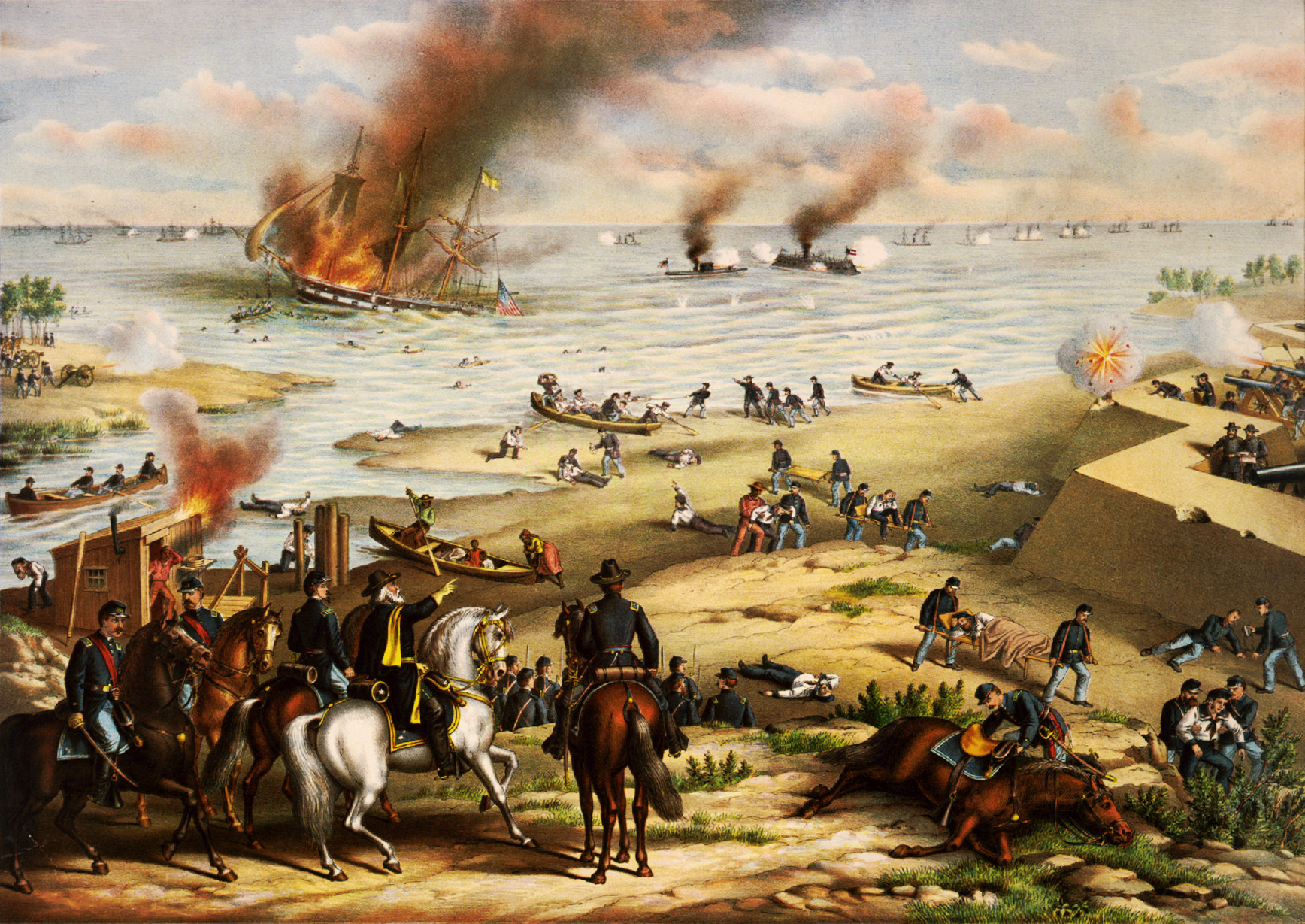
In my opinion, I believe that personal perseverance was more important during the Civil War. At first, I thought it was more important to service to one’s country, until I realized the risks and dangers of being in the Civil War. First of all, the Cumberland (the Confederacy’s ship) and the Merrimack (the Union’s ship) attacked one another at a short distance away from each other, so the battle lasted a long time. The only way to destroy an iron clad (the Cumberland) was to somehow get fire inside of the ship, which was difficult to do. People in the Confederacy and Union had to fight for long periods of time, sometimes getting injured. If someone were to get injured, they had a chance of getting worse, or dying, from the treatment. Surgeons often carried out resections on people with battle wounds. In “Under the Knife,” Terry L. Jones wrote, “Besides being a difficult procedure, resection also carried a high risk of profuse bleeding, infection and postoperative necrosis of the flesh.” Not only did people in the Civil War have a high risk of getting injured in battles, but they also had a high risk of dying from the treatment of the battle injuries.
Another danger of being in the Civil War was getting hurt from advanced weapons. In 1862, 240 patents issued for military weapons, according to “The Art of Death.” These weapons included the most important invention in the Civil War; the rifled musket. The Minié ball used in the rifled musket could kill someone at half a mile and accurate at 250 yards. The “Under the Knife” article by Terry L. Jones explains how Major General Richard S. Ewell’s left kneecap was hit by a Minié ball during the Civil War in 1862. Campbell Brown, Ewell’s aide who saw the operation on Ewell’s leg said about the Minié ball, “pierced the joint & followed the leg down for some inches. When the leg was opened, we found the knee-cap split half in two — the head of the tibia knocked into several pieces — & that the ball had followed the marrow of the bone for six inches breaking the bone itself into small splinters & finally had split into two pieces on a sharp edge of bone.” The technology of new weapons during the Civil War came with more opportunities to get hurt or killed.

With so many people killed in during the Civil War, there was no point of fighting so hard, just to lose loyal citizens. It was more important to have enough people in a community, rather than enough people to fight in the Civil War. 

Sunday, March 9, 2014

North vs.South in Civil War

In my infograph, I used the Slave Density statistics in Document A because the South had more slaves than the North, and therefore depended on the slaves' production of cotton. Normally the South traded the cotton produced by slaves for other resources that they needed for the army. President Lincoln discontinued the ports along the Atlantic Coast and the Gulf of Mexico in the South. This prevented the South from trading their cotton to Europe and receiving manufactured goods needed for the the army. I also used the Resources of Union and Confederacy statistics in Document B because the differences in numbers between the North and South impacted their armies. Since the North had a bigger population, more men were able to fight in the army, as well as having people available to maintain the land and produces resources. Also, the North had more railroad mileage, which made it easier for them to transport supplies for the army. Another advantage for the North was that they were able to make more supplies that were needed in the army because the North contained more industrial workers than the South. From these statistics, I realized how the North and South used their advantages to create strategies in the Civil War.


Link to Infograph: https://infogr.am/north-vs-south-in-the-civil-war?src=web


Tuesday, March 4, 2014

Overview of Causes of the Civil War Project

In the Causes of the Civil War class project, each group (of one, two or three students) researched one cause of the Civil War. The different topics were Bleeding Kansas, California & the Gold Rush, Caning of Charles Sumner, Compromise of 1850, Dred Scott Decision, John Brown & Harper's Ferry, Kansas-Nebraska Act, Mexican-American War, Missouri Compromise, Secession of South, Treaty of Guadalupe Hidalgo. From their research, each group made an online scrapbook so that students could learn about their cause from viewing each scrapbook. Students used things like Prezi, Weebly, and Glogster to create their scrapbook. The scrapbook included an introduction essay, at least twelve primary sources that had captions to explain how the primary source relates to the topic, and a bibliography that stated all of the groups’ sources. The scrapbook needed at least six primary source pictures and at least six primary source documents. During class, students had the opportunity to look at each scrapbook and include each cause on a timeline. Each cause needed the name of the event, the date of the event, and a brief description of the event, including how the event impacted slavery. The events were put into chronological order on the timeline.  


Note: Compromise of 1850 and Bleeding Kansas should switch places on the timeline. 
Also, I am not sure how to crop the print screen so that only the timeline shows. 

Thursday, February 13, 2014

EdCafe: A Great Way to Learn

I enjoyed the EdCafe model more than a Socrative Seminar.  I felt more comfortable saying my thoughts and opinions, since there was less pressure with the small groups. In a large group, there are many awkward silences because people do not know when exactly to talk, while in small groups, there are more opportunities for students to express their ideas. Some students do not feel comfortable talking in front of a large group. I also liked how we could pick which topic to go to. This way, I was more encouraged to pay close attention and take notes. Since students were able to pick which topic to go to, based on what interests them, people took more out of the activity, instead of sitting there bored and daydreaming. The EdCafe felt productive and comfortable for me.
                When presenting, I had many questions prepared so that I did not run out of things to talk about. There were no awkward silences where I had to improve on what to say. Even if one question did not spark a long conversation, there were plenty of other questions to move on to. The attendees seemed to have many ideas to say about my topic and questions. I used the Smart Board notebook so that students had a visual. I wrote down what the attendees said, in order to allow the attendees to know exactly what to take notes on. Next time I would change my questions in order to make them more different from each other. At times, it felt as though people were repeating the same ideas because my questions were too similar to each other. For example, one of my questions was, “In such poor conditions, what motivations did slaves have to keep on living through a life of bondage?” Another question was, “What kept slaves from committing suicide?” To answer both of these questions, people gave the ideas of family and the possibility of becoming free. There was not much difference between these two questions, which caused the group to say the same things when talking about each question. When leading, I felt successful in terms of being prepared, although I would like to improve on giving my questions more diversity.

                As an attendee, took notes on what the leaders wrote on the Smart Board. For each station, I happened to be interested in the topics that were both at the Smart Board station. Whenever another student, or myself, added to the conversation or if anything was written on the Smart Board by the leader, I would write it down. I contributed by giving the idea that slaves were physically harassed by their masters and that slaves risked sacrificing their families by escaping during the first station. I contributed my ideas to two out of the three questions that were presented. During my second session of being an attendee, I shared my thoughts for four out of the six questions that were asked. I explained how slaves were whipped and abused by masters, how the slaves had to make the decision of escaping or not and if they wanted to commit suicide or not, that family motivated them to want to survive, and how Harriet Jacobs had to make the decision of leaving her kids. I felt as though I helped the discussions move along when being an attendee.


https://blogger.googleusercontent.com/img/b/R29vZ2xl/AVvXsEineAUdWlYztWPi6Rd6OfQ27zKaljxw7KkRx9mjBqehqrG4mh0RhWmuHKyH4ta7hOIBg9Hbcpl9weHCokVFzYjZ0LGtvzq4EK4yPPVU0DESQyR-5GI_6fzPTA3ompslzU-UF4zSXKQd0pUA/s1600/EdCafe+Day.jpg


Tuesday, February 4, 2014

Rethinking Americans in the Antebellum North Against Slavery


Americans in the Antebellum North were not really against slavery on moral grounds because they thought of slaves as property, and not on economic grounds because slavery was essential to the economy. States could not prohibit slavery, but they could put a tax on slaves. The Industrial business was run by slaves. The more cloth produced, the more cotton that was consumed, and more slaves were needed to produce the cotton. The table linked to below shows that in 1834 753,270 yards of cloth was produced each week and the slave population was 2,300,000. In 1858 when 2,394,000 yards of cotton was produced each week, the slave population increased to 3,953,696. Lowell depended on the slave system in order to get raw cotton. Lowell sold the finished product to slave owners so that the owners could dress their slaves. This is shown in the “Lowell Cloth” picture below. Americans in the Antebellum North did not think of slaves as a “whole person.” They treated slaves as property.


Table of Cotton Production/Slave Population: Statistics of Lowell Manufacturers, courtesy Center for Lowell History, University of Massachusetts Lowell. http://www.edline.net/files/_wdH5g_/e9aa25b9887eebbc3745a49013852ec4/Unit_4_Activity_5_Doc_2_Cotton_Prod_v_Slave_Pop.pdf